A short story from the Rifters Universe…
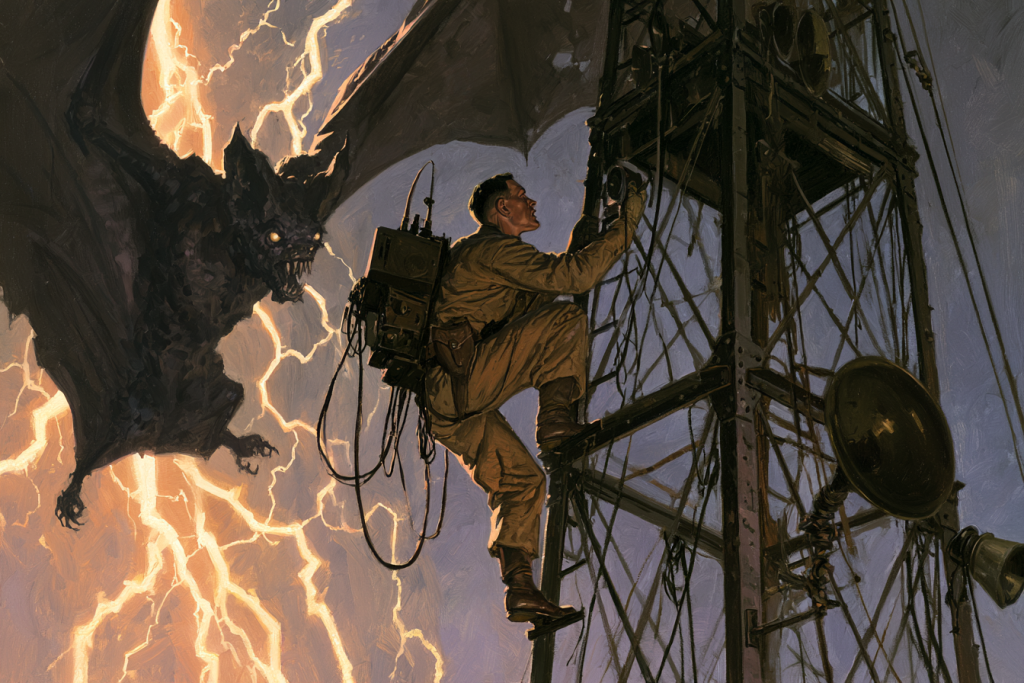
Rain drummed down, cursing the land, shaking it with hellish rolls of thunder, and jarring jolts of lightning. While Raymond Keller couldn’t hear the thunder, he could feel it if it was close enough. When he could feel it was when a storm was at its most dangerous, but the storm wasn’t the threat today. The eight-foot bat snacking on Mrs. Lassiter was.
Mrs. Lassiter stood motionless, her blouse plastered to her skin, the wind whipping her drowned hair. Unable to twitch, she was caught in the middle of a paused moment, an eerie statue suspended in the middle of life. And not just Mrs. Lassiter. Everyone in town had become a still life from a cause he had been too slow to identify. Raymond wasn’t sure if Mrs. Lassiter or anyone frozen in time breathed, yet his neighbors were depending on him, and he’d not let them down.
The bat had hopped into town days ago, barely ankle high and one wing bent, looking so ordinary, so Earthly. No one had noticed the small animals being immobilized then disappearing. Not until the people became statues and slowly disintegrated. By then, the bat was three-feet tall and everyone had been rendered immobile except for Raymond. This puzzled him as much as the bat.
The bat no longer waited until nightfall to show itself and feed. Its expression held notes of deep confusion when it spied Ray, but it showed no fear. For good reason. Nothing Raymond had tried had any effect on the creature.
The brass pistol constructed from crystals and gears, specially designed to deal with monsters from the rift, had stunned the bat briefly, but nothing to convince the bat that anything on Earth was a threat to its existence. The rift that connected Settler to forty-one other universes had thrown some strange things at Raymond and his fellow Rifters since he had joined them a six summers ago, but the bat was the strangest yet.
The first strategy Raymond had tried was stunning the bat and moving it to the clearing in the woods where the rift opened, thinking that when the portal opened, he could toss it through. He had stunned the creature, moved it a few feet before it would wiggle and he had to shoot it again. He repeated these actions until the otherworldly bat was moved across town and into the woods. In a clearing with two obsidian pillars, he waited and waited for the rift to open. After three days and nights, he had to relent to the needs of his body: to sleep, to eat, to hydrate. He tried again by setting up a campsite so he could stay an entire week, but this strategy still didn’t solve the need for sleep.
The rift couldn’t be summoned. It would open when it opened. With no way to predict when it would, he realized his plan was poor. By the time the rift presented an opportunity, the bat could be ten feet tall and far beyond Settler.
He needed another plan, and thought about bats on Earth using sound and sonar to move around and hunt. He experimented with speakers and the radio station until he briefly woke Cordelia Swit. For five minutes she tried to explain. Raymond was pretty good at reading lips, and she emphasized certain words with gestures. He understood she could hear music, and that she believed the music held everyone in place. What he really needed to know was what she heard now while awake. He asked the question and handed her the pad and pencil always in his pocket. She wrote until the pencil and pad slipped from her fingers, and she returned to the world of statues. A looming shadow alerted Raymond to the approaching bat. He snatched up the pad and ran off. The bat could barely fly, and like an Earth bat, it wasn’t designed for running. He easily outraced it, but figured he wouldn’t have advantage for long.
On his pad he read: A song so beautiful, I have to stop to listen. You broke through, but I can still faintly hear…
Wondering what kind of song could do such a thing, Raymond understood he had been on the right track but he had to be louder, direct his disruption better, and make sure it didn’t stop. He would have to do better than the ten radios he had set up around Cordelia. He chased the bat away from her, and went to the radio station, surveying the equipment, coming up with a better strategy. The solution involved a piece of equipment hidden in his closet at home. He peered over his shoulder to his house a few blocks away. Living close by had made the daily commute to the station effortless. The small size of the town also made it safer than most other places.
His hearing was a casualty of World War 1. While the loss of a sense was tragic, he knew he was fortunate and never complained. Settler had welcomed his skills when he passed through years ago on a trip to Crater Lake. The town had been setting up a radio station, and his signal corps engineering background had been the key to making their station work.
On his way back from Crater Lake, the radio station owner convinced him to stay. Settler gave him purpose. For the first time since the war, he didn’t feel like a burden or someone waiting for life to pass him by. He was part of something. When he learned about the rift and the monsters barely a year later, that feeling deepened. The rift became a calling, and he joined the small group of Rifters who defended Settler and the planet.
Raymond set up his latest attempt to defeat the bat outside the radio station. An old portable radio pack, sat under a tarp at his feet, catching the signal generated inside the station and allowing him to broadcast to the entire town for maximum impact. He had purchased the SCR-77 set at an army surplus sale seven years ago when a wave of nostalgia had hit. When he got it home, it summoned images of trenches, rot, mud, death, and blood.
As if it happened now, he could see the moment when his army service ended. His company had gained ground, made an enemy trench theirs, holding the line, readying for the next Allied offensive. The Germans attacked in a horde, defying intelligence. The phone lines to the rear had been cut, and the trench was being overwhelmed by more Germans than had been known to be the area. So many enemies should not have been there. If the enemy defeated Raymond’s company and retook this ground, it would set back the Allies for months, extending the war, increasing the body count.
Command had to be warned. His company had to be saved. Raymond had run for the portable radio pack without hesitation. The logistics of establishing and maintaining communications was his job more than shooting and tossing grenades. He reached the special bunker at the same time as Commander Daniels. The two of them understood how crucial it was to get the message out. Raymond wound the crank. Outside the room surrounded by sandbags, Commander Daniels protected the radio and Raymond. A grenade landed at Raymond’s feet. Without hesitation, Commander Daniels threw himself on top. A muffled explosion shook his body, and crimson soon stained the dirt floor. Something sharp pierced Raymond’s head. He tasted blood before he noticed it running down his face like a curtain of red in front of his eyes. He noticed he couldn’t hear what he shouted into the radio set, and didn’t know if he couldn’t speak or couldn’t hear. He screamed and screamed without hearing a sound and had never heard again.
The radio brought that moment to mind over and over until he had quickly stuffed it in a closet, regretting hauling it home, regretting the ghosts and horror it summoned, but it must have done its job, because Raymond had woken in an army hospital then made it home. Only twenty men from his company survived. The rest remained in the fields and cemeteries of Northeastern France.
Now here was the radio set, helping people survive another battle. He spliced wire to the horn speaker. He would set it up on the radio tower where the signal would be the least interfered with, the least likely to get interrupted. He glanced at the bat, satisfied it continued to find Raymond uninteresting. He arranged the spool of wire on the backpack so it would let out smoothly as he climbed. Satisfied, he carefully packed some tools and the horn speaker. Hands on his hips, he gazed up at the radio tower, the rain lashing at his eyes.
If the bat kept ignoring him, his greatest enemy was the storm. One lightning strike on the tower and he was a goner. By timing the vibrations of thunder under his feet and the lightning strikes, he determined the storm was moving away. He prayed it wouldn’t stall.
“Metal tower, lightning storm, rain slicker than slug slime, and a giant bat. What can go wrong?” He couldn’t hear himself. Some friends had asked him why he spoke to himself. “Because I’m still human,” he had answered.
From years of experience, he spotted the exact spot where he had to attach the speaker. About a hundred feet up to get the signal over all the rooftops and trees.
“Here we go.” He kept his eyes on his goal and took a deep breath. As he climbed higher, he mapped each handhold and foothold before moving.
The radio tower was a three-hundred-foot lattice of steel, four narrow legs reaching toward the clouds and tapering as they rose. Horizontal braces connected the sides every few feet, with diagonal supports crossing between them in a repeating pattern. The tower wasn’t a solid structure but a skeleton of metal, every surface exposed to the wind and rain. The crisscrossing beams were perforated with gaps large enough for his fingers to grip, and one of those openings would hold the horn speaker in place. Raymond could feel the strong, relentless wail against his back.
At about fifty feet, the bat realized Raymond was up to no good. It hopped faster than Raymond had ever seen it move to the base of the tower. He couldn’t let it catch him, couldn’t let it prevent him from saving the town. He urged his hands, feet, and muscles to move faster.
The rain made his holds precarious. His fingers shook and slipped. His booted feet sometimes caused his heart to pound, preferring air over purchase. Glancing over his shoulder, his stomach rose in his throat. The bat was gaining. Its one good wing gave it superlative balance.
He made it to his target, breathing heavily, with no time to rest. “Go, go, go,” he rallied himself, then swore. Where he needed to attach the speaker, the horizontal brace that would allow him to stand steadily beneath it was broken. The diagonal brace with holes was fine. It was getting there that was the problem. He could go higher, but that would weaken the signal. Lower risked interference.
The rain sloughed off him and the tower in sheets. He peered far below at his fellow Rifters and the people of Settler who had become family. He couldn’t let them die by weird bat from another universe, and if he failed to stop the bat, it would soon devour the rest of the world. He was their only hope, just like that day in war.
The horn speaker seemed to gain weight as he pulled it out of his pack. It glistened under the shellacking of rain. He pushed the bolt through the bracket, making sure it wouldn’t fall out. Removing the wrench he needed and detaching the spool of wire, he let the pack fall toward the bat.
The maimed bat ducked, but the falling pack clipped its bad shoulder. Its nostrils flared at Raymond with a heated rage that fueled its climb. It moved at a furious pace.
Raymond could reach far enough from where the horizontal brace ended to start to tighten the bolt, but to finish the job, he’d have to dangle from the diagonal brace by one hand, and there’d be no coming back.
Placing the wrench securely in his pocket, he concentrated on the diagonal brace he needed to reach. Without a second thought, he jumped, his body flying through the air, the rain, and the thunder, reaching for hope. His hands gripped, and his body jerked. He shrieked and gritted his teeth as his hands and shoulders screamed. His fingers threatened to give way, sliding down the slant of the diagonal until they caught a firm hold.
His flailing body stabilized, and he climbed hand over hand toward the horn speaker. One hand let go and fumbled for the wrench. The entirety of his attention was on the horn speaker and the bolt, on getting it in the right position. While he couldn’t hear the notes and noise the speaker blasted, he could feel the vibrations. He tightened the bolt, adjusted the speaker, tightened again, adjusted again. Finally, the speaker stayed in place, and he could tighten and tighten and tighten without stopping.
When the wrench refused to budge any further, he let it fall and put his other hand on the diagonal brace. He swung toward a foothold. Maybe he’d make it.
The bat had other ideas, lunging. Taking a firm hold of him, its claws raked down Raymond’s sides, and it bit his shoulder. The teeth sank deep, and the bat smelled worse than wet dog. Blood and fetid flesh filled Raymond’s nostrils, and the bat ripped him from the tower. The two of them tumbled, rolling end over end, possibly screeching. Finally, the bat let go and used its one good wing to save itself. It glided safely onto a horizontal brace and leered down at Raymond, its body convulsing as if it laughed.
The disappointment of the bat’s triumph accompanied Raymond to the ground. The landing caused pain worse than the grenade that had cost him his hearing in the war, as if his entire body was flattened by a collapsing trench.
He couldn’t hear his groans, but he felt them. His throat grew raw and hot. The rain did nothing to soothe it. He couldn’t move, could only stare up at the leaden sky, wondering if he had done enough.
The sky shimmied and there was Commander Daniels peering down at him, the one who had made sure the warning went out on the radio, and Raymond could hear him perfectly.
“Excellent work, son. I’m proud of you. Time to go. The rest of the company is waiting.”
“Did it work?” Raymond croaked. “Did I save them?”
“You did, son. You always find a way to get your people through.”

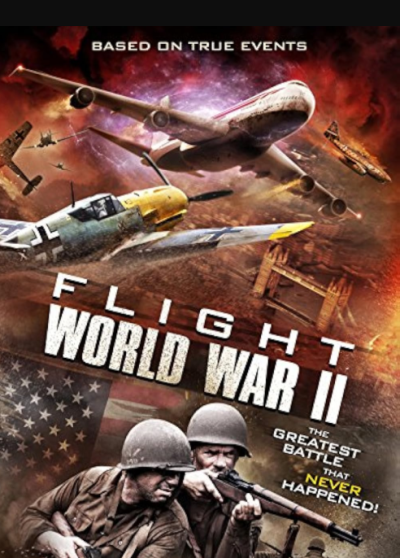 Sometimes a movie doesn’t have a massive budget or jaw-dropping special effects, yet still manages to be entertaining. Flight WW II falls squarely into that category.
 Because of that, I’m upgrading the rating from 2.5 beers to 2 beers. Two beers would definitely make it better. It’s not a great film, but it’s far from terrible. It’s entertaining enough if you go in with the right expectations. It was made by the Asylum, the same brilliant folks that made Sharknado (one of my favs).