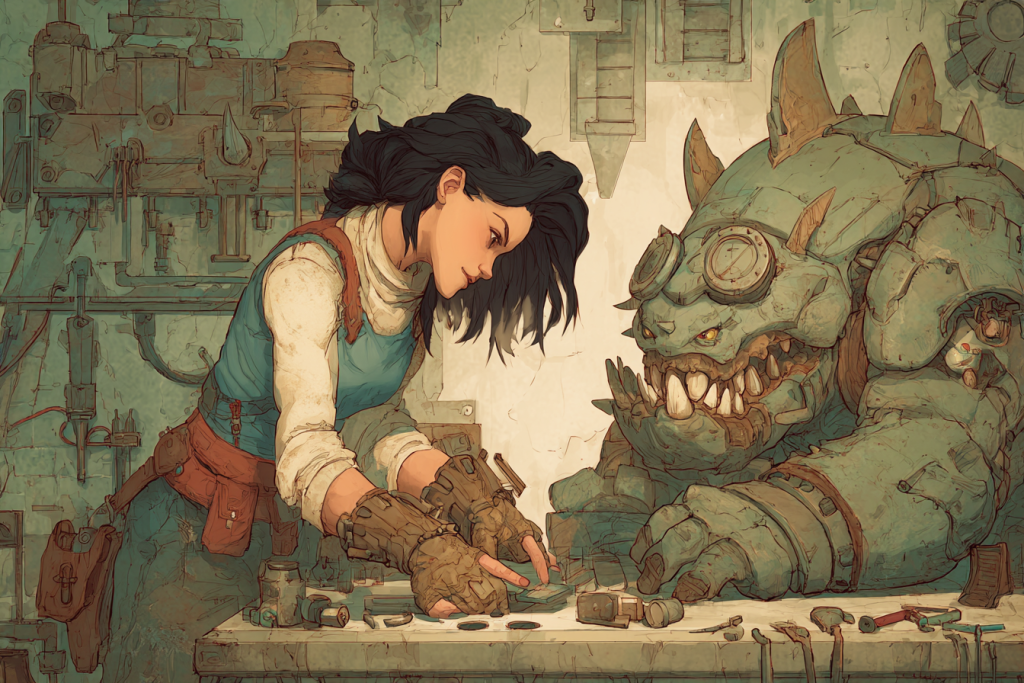
A monster isn’t just something scary. It’s a function of your story. So before you decide what it looks like, you need to decide what it does.
Start with Purpose
What role does the monster play in the story?
Is it an obstacle? A mirror? A consequence? A catalyst?
If you don’t know what it’s for, you’ll end up designing something that looks interesting but doesn’t actually belong.
Decide How It Can Be Known
Can the monster be seen directly? Touched? Studied?
Or does it only exist through effects such as missing people, broken systems, altered environments?
This choice controls how your reader experiences its presence before they ever meet.
Tie It to the Character Arc
A good monster doesn’t just exist in the world. It pressures the protagonist’s development.
What does it force your character to confront? What skill, belief, or limitation does it expose?
This is where the monster stops being decoration and starts becoming story structure.
Shape the Appearance Last
Once you know function, visibility, and narrative role, then you decide what it looks like.
Familiar? Symbolic? Entirely alien?
The design should serve meaning, not the other way around.
Define the Emotional Impact
What is this monster meant to make the reader feel?
Fear? Awe? Unease? Curiosity? Disgust?
Even more importantly, does it reinforce that emotion through form, behavior, and consequence?
Example: The Albino Tree (The Reader: Rifters Book 3)
In The Reader, I needed a monster that could emerge after the Rift closed. That immediately created a constraint: the Rifters wouldn’t have been able to detect it in the usual way. There is a hard world has rule for how monsters can be detected in the Rifters. So I couldn’t just cheat and say they missed it. I had to design something that could logically stay hidden. That limitation shaped the solution, and I came up with a seed that grows into a monster tree.
From there, I built outward.
I wanted the creature to feel misunderstood rather than purely evil, so it developed the ability to create pod people, distorting reflections of the environment rather than traditional victims.
I also wanted scale and presence. Trees already carry that sense of ancient weight, and there’s something inherently unsettling about them when they move beyond natural boundaries (think Wizard of Oz trees).
Finally, I needed the tree’s existence to matter to the protagonist’s development and the increasing tension of something being off about the rift. The encounter had to push the MC deeper into their Rifters abilities and force growth both in her own estimation and others.
So the monster wasn’t just designed, it was derived from story constraints, emotional intent, the series arc, and character progression.